Showing posts with label Products. Show all posts

Tuesday, May 29, 2012

Shea Butter...Unrefined VS Refined


When it comes to Shea butter, you have two choices. Unrefined or Refined, but which do you choose? First let me back up for a minute and tell you a little bit about Shea butter.
Shea butter is derived from the seed of the Shea tree in Africa. It contains both vitamin A and E. It's not only used in the hair, but also to treat skin conditions like wrinkles, eczema, blemishes and dermatitis. It is also used to treat insect bites, sunburns and frostbite. The differences between unrefined and refined is how the two are processed. Both of them have the same origins from the Shea tree. The nuts are harvested and crushed to extract the butter. It it during the extraction process where you can distinguish between the two.

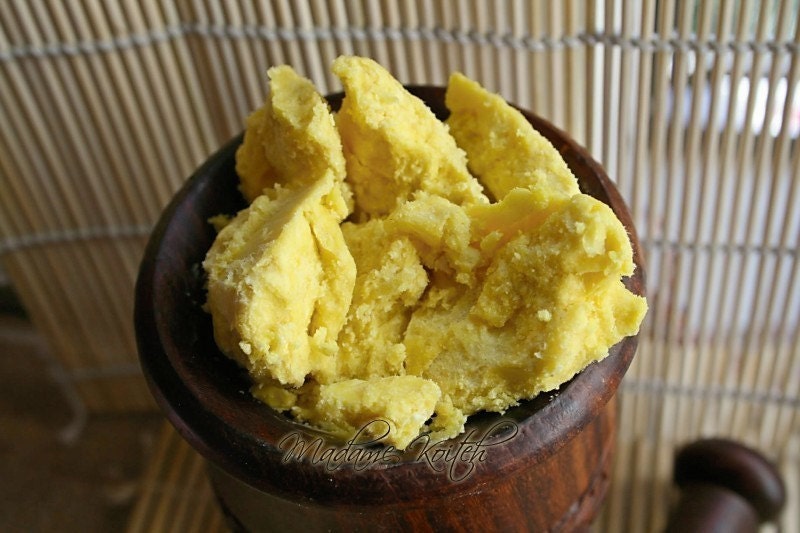
Unrefined Shea butter is extracted using water only, either by hand or machines, without the use of chemicals and synthetics. This end product is also commonly known as raw Shea butter or organic Shea butter. Its color ranges from beige to light golden yellow and its texture is usually grainy. This method will keep all the vitamins, minerals and other properties of the Shea butter intact. Unrefined Shea butter has a smoky and nutty smell which can be unappealing to consumers. I find adding essential oils such as rosemary, peppermint or lavender help to disguise the smell.

Refined Shea butter is extracted using hexane and other petroleum solvents. It is then refined and bleached by heating it to high temperatures. Other additives and preservatives are also added to remove the nutty smell, resulting in it becoming odorless. It is also white in color which is more physically appealing instead of the yellowish color of the pure traditional Shea butter. This type is also smooth in texture because they have been refined to get rid of the grainy molecules. During the refining process, Shea butter loses many of its vitamins and minerals.

So, which do you choose? Unrefined Shea butter has the highest concentration of vitamins, antioxidants and benefits that you could possibly get. If you do not mind the nutty smell, go for this type because they are far more effective compared to refined ones. They are, however, more expensive compared to refined ones and you would have to learn how to store Shea butter properly so that they can last longer.

Remember, Shea butter is not a good moisturizer, as it doesn't contain any water. Applying it to dry hair can result in locking moisture out of your hair, making it brittle and prone to breakage. It is, however, an excellent sealant for the moisture that you do put into you hair. I like melting my unrefined Shea butter in a plastic container by immersing it into a cup of boiling hot water. Then I'll add coconut oil, lavender oil, rosemary oil, sweet almond oil and grapeseed oil to it. I'll apply a good moisturizing leave in conditioner to my damp hair and seal it in with the Shea butter concoction, concentrating on my ends. Mix and match to come up with a concoction that your hair will love. LOVE YOUR HAIR!!!


Friday, August 26, 2011

More Harm Than Good


One of the main things I've learned in cosmetology school is how important it is to have product knowledge to inform clients of how their hair will benefit from using them, but one thing they don't teach us in school are harmful ingredients in hair products that could damage not just your hair, but also be hazardous to your health.
All beauty products are required to have a list of ingredients somewhere on the packaging. It is important to not only read the list, but also understand what you are reading so you will know what to avoid. The Federal Trade Commission orders that ingredients that are present in higher amounts in the product go to the top of the list. I've always been told the most important ingredients of a product are the first five on the list. Sometimes the active ingredients are on a separate list. Also, according the the International Nomenclature of Cosmetic Ingredients (INCI) system, ingredients have to be named using their scientific names and for plants, Latin names. Sometimes you'll find the English name in parenthesis, for example, Shea Butter is often listed as Butyrospermum Parkii (Shea Butter).
With all that being said, how do you know what is harmful to the hair??

Here are list of the most harmful ingredients found in hair care products
Sodium Lauryl Sulfate/Sodium Laureth Sulfate:
I have blogged before about the benefits of using sulfate free shampoo, so here is a reiteration of the harmful traits of sulfate. Both of these sulfates are cheap, harsh detergents that are found in the majority of shampoos. They are used to create lather or foam. A super lathering shampoo is not necessary to cleanse the hair and scalp. All that excess lather is just to make you think your shampoo is working properly. These sulfates are also commonly used in car washes and engine degreasers. They are generally derived from petroleum, also a harmful ingredient, and often cause eye irritation, scalp irritation and tangled hair.
Now to flip the script just a second on sulfate free shampoos...If you are using one, that's great, but just be careful!! Sometimes, when a company removes the sulfate from their product, they add salt (sodium chloride). Salt is just as bad, if not worse for your hair. Salt is abrasive or rough. If you shampoo your hair with a salt containing product, you're actually creating friction on your hair (think of an exfoliating scrub in your hair...no good!) Not to mention that it's strips the hair of moisture.

Parabens (methyl, propyl, butyl, and ethyl):
Parabens are added to hair products to act as a perservative, inhibiting microbial growth and extending the shelf life of the product. Unfortunately, parabens are also estrogenic and disruptive of normal hormone function. Exposure to these parabens has been linked to breast cancer. They've also been known to cause allergic and skin reactions.

Diethanolamine (DEA) and Triethanolamine (TEA):
These ingredients are synthetic emulsifiers and/or foaming agents. They are highly acidic and can cause allergic reactions, eye irritation, and dryness of the hair and skin. DEA and TEA are ammonia compounds, which are potent carcinogens or cancer causing. DEA can also strip away vital amino acids from the hair and the skin, like keratin. This will leave the hair feeling dry and unmanageable.

Formaldehyde:
This ingredients has become a hot topic since the emurge of the hair treatment the Brazilian Blowout. Which turns frizzy unmanageable locs into luxurious bone straight hair, but tests have determined that the product contains unsafe levels of formaldehyde or embalming fluid-a known carcinogen. Adverse reactions to formaldehyde can include allergies and affecting the nervous system.

Mineral Oil and Petroleum:
For years black women have caked "hair grease" onto their hair and scalp in hopes of achieving hair growth of some kind. I can remember my mother slathering Blue Magic onto my head every other day to help with "moisturizing" my hair and scalp. I don't mean to burst your bubble if this is still a practice you use today, but you are doing your hair and scalp no good with these products. These ingredients give the hair an artificial shine and are cheap to make and sell. Mineral oil and petroleum clog the pores on the scalp making hair growth null and void. They also coat the hair strand making it impossible for moisture to get in, which makes hair much more susceptible to damage and breakage in the long run.

Now, I know you may say, "But Tasha, trying to avoid these products can be expensive!" And you are right! Think about this though...if you ask someone who has had or is battling cancer if they would pay just a little bit more  in order to avoid the ratchet disease, what do you think they would say? I'm thinking the answer would be YES! To step down from health concerns, just think about how the hair can thrive from not subjecting it to such cruel and unusual punishment.

So, it is up to you to READ THE LABELS of your hair care products and gain knowledge of the ingredients, with these harmful products lurking around every corner being advertised as "helpful" or "good" for our hair, ready to strike at any moment.

Friday, July 15, 2011

Acid VS Alkaline...the importance of pH balance in the hair

First lets talk about what pH balance is. pH is a medical term that describes the balance of your system and it refers to the condition of metabolic changes. It stands for potential hydrogen. The pH of any solution is the measure of its hydrogen-ion concentration. The higher the pH reading, the more alkaline and oxygen rich the fluid is. The lower the pH reading, the more acidic and oxygen deprived the fluid is. The pH range is from 0 to 14, with 7.0 being neutral. Anything above 7.0 is alkaline, anything below 7.0 is considered acidic. Water is 7.0 on the scale (neutral).
Why is it so important to know how to balance pH? Our hair produces a natural oil called sebum. Sebum maintains the moisture and balance in our hair. The hairs natural pH balance is between 4.5 and 5.5 on the scale. That means the hair is naturally acidic, so the products we use in our hair should also be acidic. To know what products to use in your hair, you have to know the right level of pH for your hair. For example, the pH of hair(4.5 to5.5) is close to 2.9, which is the pH of Apple Cider Vinegar. Rinsing your hair with ACV will help balance the pH of your hair and remove the buildup from products. Dilute it with water to get the right balance (1 part ACV to 2 parts water). Some products such as sulfate shampoo, conditioners, hair colors, permanents and bleaches are strongly alkaline, which can put our tresses in a stressful state as the pH of these products is way off from the pH of hair. Water is the most alkali substance that should be used in the hair. Any other substance higher than 7 should NOT be used on the hair, relaxers included. Products with pH's lower than 4.o and higher than 7.5 can eventually reak havic on the hair.
Your hair consists of three parts. The outermost layer is the cuticle and inside of that is the cortex. The medulla is the central, most internal portion of the hair shaft that contains excess cells and air. When your hair is damaged, the scales on the cuticle stand out and break off. This exposes the cortex which makes your hair feel harder. The cortex is what gives your hair its strength and its elasticity.  By nature, curly hair cuticles tend to remain in an open state, as the spiral pattern of a curl makes it extremely difficult for the cuticles to lie flat. Since these open cuticles are what cause frizzy hair, it is particularly important for curly heads to be aware of the pH levels of the products they use. 
Alkaline products means that the pH level is 7 and above. The cuticle opens when an alkaline substance is added to it. A lot of shampoos are made to be neutral or at times, slightly alkaline. The high pH will allow the shampoo to easily clear off any oils or dirt that have formed on the hair and scalp. Neutral shampoos may be recommended for people who have sensitive scalps. In the same manner, hair conditioner is usually acidic or carries a low pH, because it causes the keratin on the hair strand surface to be flattened out instead of bristly, thus causing hair to be smooth and soft.
Ultimately you want your cuticles to lay down, so staying within the natural balance of the hair would be ideal, which is why you want to gravitate to acidic products. Purchasing pH strips and testing the balance of the products before applying them to your hair is the best way to maintain your pH balance in your hair. Check the bottles on your products, some will tell you if it is pH balanced or not. It may be neccessary to tweak some products to balance them out. For example, you may notice that some shea butters or other butters make your hair look dull. This is because typically, butters have a pH of 6.0, which don't close the cuticles all the way. Using aloe vera juice, which is acidic, with the butter will close the cuticle more, giving it more shine. Another ancient Chinese secret for laying those cuticles down is cool water. When shampooing your hair with warm water, it raises the cuticle. Try rinsing your conditioner with cool water to close the cuticle and seal the product into the hair strands, giving it the moisture it needs.
It is important to understand why some products can strip the hair of its natural moisture and cause the hair to be dry and brittle, and others aid in restoring moisture. Once you start to learn your hair and the proper pH balancing, you will be amazed at how much your hair will thrive and flourish.

To order pH strips visit http://www.luvnaturals.com/

Check out this video from Kim Love


Related Posts Plugin for WordPress, Blogger...