Showing posts with label Hair Protection. Show all posts

Monday, September 24, 2012

When It's Cold Outside....

Keeping The Hair Moisturized During Cold Months


OK naturals, it's starting to get cold outside. Cold air means dry air which means dry hair. I have blogged of this topic several times and will continue to do so as hair moisturization is so essential for healthy natural  hair. During this time of year, moisture is especially imperative to combat the dry brittle hair you are sure to experience. Selecting a good moisturizing conditioner is a perfect way to help your hair fight the fall and winter months. Click on the source to read an article from The Science of Black Hair. It dispels just what to look for in a moisturizing conditioner. The only thing I would add to the article is to make sure you use a natural oil to seal in the moisture that you put in your hair.

Your hair doesn't have to suffer during the fall and winter months. Taking necessary precautions will help to insure that your hair stays radiant and healthy. LOVE YOUR HAIR!!!


Wednesday, July 11, 2012

Oh What a Tangled Web We Weave....


Tips, tools and methods for detangling

Detangling can be one of the most daunting tasks of the natural hair world. Though it is a complete pain in the you know what, it is a necessary task if you wish to maintain your hair properly. It can be a constant battle between getting out the tangles and removing shedded hair without snagging and over manipulating it. So, let me give you the low down of some methods and tools that may help you get through this grueling ordeal.

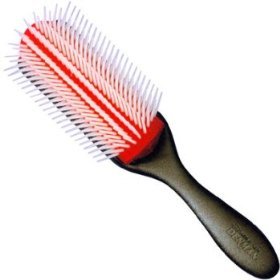
The Denman Brush


The Denman brush is one of my favorite detangling tools. When used properly, you can get smooth, defined and frizz free curls. The Denman was specifically created for the maintenance of curly hair. The fact that it has somewhat flexible teeth and it catches the shedded hair to prevent matting, makes it very popular amongst naturals. It can also be opened to remove columns of teeth and make the spacing wider for those whose hair can't tolerate all the teeth.


The smooth back of the brush is what helps to smooth and polish the curls without frizzing. It's also perfect for distributing product evenly through your hair.


Your Fingers
Well, fingers aren't really a tool, but they do the trick when it comes to getting tangles out of your hair. Using your fingers as opposed to a comb or brush allows you to "feel" the tangles and carefully separate the hair and ease them out. Finger detangling is especially benefiting to naturals with fine hair that splits and breaks easily. This is hands down (no pun intended) the gentlest way to detangle your hair, but also the lengthiest. I don't recall ever using any other tool in my hair besides my hands the first year after my big chop.

The Tangle Teezer


I, personally, have not used the Tangle Teezer. Honestly, the look of it kind of worries me a little, but I did research it and found it can actually be quite helpful. In what I read,  the Tangle Teezer does what it's supposed to do very efficiently. The teeth are extremely flexible, causing tangles to literally melt away. Instead of just getting stuck in the tangles or ripping them out, the Teezer gently coaxes the tangles until they unwind. I also read that the scratching noise the tool makes can be a little freaky and may cause you to keep checking to see that you aren't ripping hair out of your head.
The one con that I read was the fact that the tool has no handle. Although it was designed to fit into the palm of your hand, it could become a nuisance once it gets wet and starts slipping and sliding all over the place.


Wide Toothed Comb


Another one of my faves, the wide toothed comb is probably the most preferred tool amongst naturals.
The reason is because it can detangle efficiently and remove shedded hair with minimal damage, with the wide spaced teeth that are large and seamless. I even keep one hanging in my shower.

Now that you have some tools and tips, let's take a look at a couple of detangling methods.

Dry Detangling
When I am getting ready to shampoo and condition my hair is the ONLY time that I dry detangle my hair. I do so my applying either conditioner, coconut oil or both to my hair. I let it sit about 15 minutes then GENTLY use a wide toothed comb or my fingers...preferably my fingers to separate my curls. I call it pre-detangling. By both separating and lubricating the hair before a shampoo, It makes for an easier wet detangling session. The hair has less tangles and you've added extra moisture to the hair to help protect it from the stripping shampoo can cause.  Dry detangling is especially beneficial if you'd had your hair in a twist style.

Wet Detangling
This method should be the main way of detangling the hair. It's done when the hair is sopping wet and very well lubricated with conditioner. Doing this creates slippage and causes your tool to glide easily through your hair. I prefer using a wide toothed comb, but the Denman brush also works very well for this method.


You can get the best results when you do both dry and wet detangling. If you can get in a good  dry detangling session before shampooing it will improve your results when you detangle with wet hair and conditioner.

A couple of DO's to take with you are:
DO take your time and be as thorough as possible. The last thing you want to do is think you've done a good job detangling only to find a nice wad of matted hair in your curls.

DO section your hair prior to detangling and use as many sections as you need. This will become more important as your hair grows. The longer your hair is, the easier it is to knot up. If you handle your hair in sections, it makes it easier to manage and to do a thorough job.


In conclusion, it doesn't matter how often you detangle, whether you do it wet or dry, or which tools you use. Just remember to do what is best for you and your hair.

LOVE YOUR HAIR!!

Friday, June 8, 2012

Protecting Your Hair While Swimming

It's hot outside and if you are anything like me you enjoy a nice refreshing dip in the pool. While that is all good and gravy, there are some steps you need to take to keep your hair from getting damage from the chlorine or if you are on the beach, salt water.

The first thing you need to do is rinse your hair with tap water before getting in the pool. If your hair strands are filled up with water, then it won't be able to absorb any of the chemical laden chlorine water, lessening the effects it can have on the hair. After swimming, rinse your hair with tap water again. If you are going to stay in the sun, it is best to wear a hat.

You should coat your hair in an inexpensive conditioner before getting in the pool to help to create a protective barrier from the chlorine water. You can also use a natural oil, like coconut oil.

Using a swimming cap is a good option. While they may not keep your hair completely dry and chlorine free and  most people believe them to be unattractive, that extra bit of added protection is worth the sacrifice. On the downside, swimming caps can sometimes be too tight on the head, causing you to pull your hair out when taking it on and off. If this is the case, refrain from using them.


Wearing a protective style, such as braids or twists will help, so less hair is exposed to the water. Braid extensions are also good. Just remember your hair still needs extra care before and after swimming, whether in a style or not. So, make sure to implement cleansing and moisturizing just the same.


Be sure to shampoo your hair after you are done swimming for the day. It's important to use a shampoo that gets rid of the chlorine and mineral build up. Take note that although you rinse your hair after swimming, that is not ridding the hair of chlorine. If you swim every day, then you will need to shampoo everyday. If you're a frequent swimmer, you may need to purchase a special shampoo made for swimmers. You must also remember to condition your hair after each shampoo.

So, that's it! Have a safe and fun summer, but keep those tresses healthy and protected. LOVE YOUR HAIR!!!


Thursday, October 20, 2011

Taste the Rainbow...Coloring Natural Hair


There has been a long time question as to whether or not color is good for natural hair? My answer is, any hair that is chemically altered in any way is not good, but proper care will make it okay. Make sense?? Plus, if you are afraid of chemicals you can always use a rinse, which just deposits hair on top of the hair strands. With that being said, let's talk about your options.
There are three main types of color--permanent, semi or demi, and temporary.


Permanent hair coloring products consist of two components that are packaged separately and mixed together...hydrogen peroxide and an ammonia dye solution.
As soon as the ammonia dye solution and the hydrogen peroxide solution are mixed together, they are applied to the hair. The ammonia in the mixture (less than 1% concentration) causes the hair to swell and the cuticle scales to separate a little. After this happens, the dye is able to penetrate the cuticle before they have fully reacted with each other and with the hydrogen peroxide. This is why even when brown hair coloring is first applied it looks whitish. This is also why you have to wait a half hour or more for the color to develop. Long story short...the hair cuticle is lifted and the proteins that give us our natural hair color are altered. Sound pretty damaging? Permanent coloring definitely has an effect on the moisture protein balance because there is a chemical reaction that is taking place inside the strand weakening the cuticle layer causing the hair to be more porous. The more porous the quicker your hair absorbs moisture. If it’s too porous the hair doesn’t retain any moisture and remains dry to the touch.  This is always a risk with permanent coloring hair. 


Semi permanent hair color is good for first-time dyers or for people who aren't looking to make a drastic change. Semi permanent dye has no ammonia and no developer, so no color is deposited inside the hair shaft. Instead, it coats the hair, which is why it's often referred to as a "stain" or "wash." Semi permanent is good for changing or enhancing tones but not for changing colors. It generally washes out in 6 to 12 shampoos. While
Demi permanent hair color is good for people who want more of a change but do not want to damage their hair or do anything drastic. It contains no ammonia but does have a small amount of peroxide, which opens the hair cuticle slightly so that some color will sit in it. Demi permanent does a better job of darkening hair than semi permanent does, but it doesn't lighten hair. Demi permanent hair color will fade and typically lasts 12 to 24 shampoos.


The third type of coloring is temporary. Temporary hair colors are applied in the form of rinses, gels, mousses, and sprays. They coat the surface of the hair and usually wash out within two or three shampoos. Temporary hair color is typically brighter and more vibrant than semi-permanent and permanent hair color. It is most often used to color hair for special occasions like Halloween or costume party.

There is also a "natural" hair color that a lot of naturals swear by and that's Henna. Henna is a plant native to subtropical regions of Africa, Southeast Asia, and Australia. You may know it as a way of doing body art. Natural henna is said to make your hair knockout glossy and give it a rich red tint. If the package claims to color hair blond or black, it is not natural henna.  Compound hennas, which make the other color claims, have additives, they also contain metallic salts and chemical lighteners that can wreck your hair. So unless you're going any color besides true red, be sure to read the box carefully. Body Art Quality Henna is what you’re looking for. Henna is also said to provide a deep conditioning treatment. Some say it “loosens up the curl.” Everyone’s experience will be different. 
If your hair has been previously dyed or bleached with regular drugstore or salon dye, the remaining chemicals and pigment molecules from your last dye job can interfere with the henna, causing uneven color and even weird pigment results, like green hair. If you've been dyeing your hair with anything other than henna, you'll need to do a couple of strand tests to make sure.
Henna comes in a powder form and must be mixed with an acidic liquid to form a paste. Also, unlike chemical dyes, henna can be messy, and it may take a long time to dye your hair. Some people leave it on as long as 24 hours and wrap their hair in plastic wrap to keep in the heat and speed up the dyeing process.
I'll do a whole post concerning Henna in the near future...


Now that you have decided on the type of  hair color that is best for you, how do you take care of it? You need to understand that every time you apply permanent and semi-permanent hair color, you subject your hair to a chemical process and we all know chemicals are damaging to the hair cuticle. 
 Use a shampoo and conditioner specially formulated for color-treated hair. These products have extra moisturizing ingredients to hydrate brittle strands and make color brighter. The harsher shampoos can strip the color from your hair, making it look dull and faded.  Deep condition your hair often. My hair is color treated and I deep condition every week, rinsing with the coldest water that I can stand. While hot water raises the cuticle, releasing the color from your strands, cold water will seal the cuticle, closing the color in.
Moisturize, moisturize, moisturize! Find something that works for you and keeps your hair from drying out, like a good daily leave in conditioner. Dryness will lead to breakage.
Stretch out the time you re-apply your coloring, if you re-apply too soon you may suffer from over-processing.
When you do your retouch, start your application at the root. If you feel that your ends are dull apply the color from the root down during the last few minutes of the process.
Trim your hair up to 1/2 inch every 6-8 weeks, to avoid splits and breakage.
Implement protective styling to protect the ends of your hair from damage.

Hair dye is only as damaging as you make it out to be, maintaining healthy color treated hair is all in the care you provide. Keep in mind that most women with kinky or tightly coiled hair suffer from dry hair and hair dying can add on to this issue if the proper measures are not taken.
With all that being said Happy Coloring and LOVE YOUR HAIR!!!!


Monday, September 19, 2011

Winter Hair Care

We are in September now, the time of year when the weather begans to cool down. People began preparing their homes, cars and even their wardrobe for the winter months just lerking around the corner. This should also mean a change in your hair care regimen.
During the winter months the air becomes dry and if you don't take some necessary precautions, your hair may pay the price. The harsh cold can cause more dryness in our already moisture deprived natural hair. If you wear winter hats,which are normally made of wool or cotton, it is best to cover your hair with a satin or silk scarf under the hat so that the hat doesn't pull all of the moisture from your hair.
A lot of naturals opt to wear protective styles in the winter months to guard the ends of the hair from the harsh elements. Buns, braid extentions or weaves are good winter styles to consider. They are generally low maintenence, so little to no combing will be necessary, helping you to preserve your hair even more.
It is a good idea to avoid humectants during the winter months too. A humectant is a substance that promotes retention of moisture. Common humectants are honey, glycerin, panthenol, and propylene glycol. These are excellent summer staples, because they draw moisture from the humid air into our hair. During the winter months, however, they may have the opposite effect, potentially drawing out the moisture from your hair into the dry air that winter brings.
Doing weekly deep conditoners is a good way of replinishing lost moisture, also frequent hot oil treatments. Also, don't forget to seal in your water based moisturizers with either shea butter, castor oil or whatever natural oil you choose.
In conclusion, the best way to combat winter damage is to be proactive. If you start out with your hair strong and healthy BEFORE winter strikes, it will be a lot easier to maintain and preserve DURING the winter. Adopt a weekly routine of shampooing with a moisturizing shampoo, a good deep conditioner and good moisturizer that doesn't contain mineral oil or petroleum.  

Friday, August 26, 2011

More Harm Than Good


One of the main things I've learned in cosmetology school is how important it is to have product knowledge to inform clients of how their hair will benefit from using them, but one thing they don't teach us in school are harmful ingredients in hair products that could damage not just your hair, but also be hazardous to your health.
All beauty products are required to have a list of ingredients somewhere on the packaging. It is important to not only read the list, but also understand what you are reading so you will know what to avoid. The Federal Trade Commission orders that ingredients that are present in higher amounts in the product go to the top of the list. I've always been told the most important ingredients of a product are the first five on the list. Sometimes the active ingredients are on a separate list. Also, according the the International Nomenclature of Cosmetic Ingredients (INCI) system, ingredients have to be named using their scientific names and for plants, Latin names. Sometimes you'll find the English name in parenthesis, for example, Shea Butter is often listed as Butyrospermum Parkii (Shea Butter).
With all that being said, how do you know what is harmful to the hair??

Here are list of the most harmful ingredients found in hair care products
Sodium Lauryl Sulfate/Sodium Laureth Sulfate:
I have blogged before about the benefits of using sulfate free shampoo, so here is a reiteration of the harmful traits of sulfate. Both of these sulfates are cheap, harsh detergents that are found in the majority of shampoos. They are used to create lather or foam. A super lathering shampoo is not necessary to cleanse the hair and scalp. All that excess lather is just to make you think your shampoo is working properly. These sulfates are also commonly used in car washes and engine degreasers. They are generally derived from petroleum, also a harmful ingredient, and often cause eye irritation, scalp irritation and tangled hair.
Now to flip the script just a second on sulfate free shampoos...If you are using one, that's great, but just be careful!! Sometimes, when a company removes the sulfate from their product, they add salt (sodium chloride). Salt is just as bad, if not worse for your hair. Salt is abrasive or rough. If you shampoo your hair with a salt containing product, you're actually creating friction on your hair (think of an exfoliating scrub in your hair...no good!) Not to mention that it's strips the hair of moisture.

Parabens (methyl, propyl, butyl, and ethyl):
Parabens are added to hair products to act as a perservative, inhibiting microbial growth and extending the shelf life of the product. Unfortunately, parabens are also estrogenic and disruptive of normal hormone function. Exposure to these parabens has been linked to breast cancer. They've also been known to cause allergic and skin reactions.

Diethanolamine (DEA) and Triethanolamine (TEA):
These ingredients are synthetic emulsifiers and/or foaming agents. They are highly acidic and can cause allergic reactions, eye irritation, and dryness of the hair and skin. DEA and TEA are ammonia compounds, which are potent carcinogens or cancer causing. DEA can also strip away vital amino acids from the hair and the skin, like keratin. This will leave the hair feeling dry and unmanageable.

Formaldehyde:
This ingredients has become a hot topic since the emurge of the hair treatment the Brazilian Blowout. Which turns frizzy unmanageable locs into luxurious bone straight hair, but tests have determined that the product contains unsafe levels of formaldehyde or embalming fluid-a known carcinogen. Adverse reactions to formaldehyde can include allergies and affecting the nervous system.

Mineral Oil and Petroleum:
For years black women have caked "hair grease" onto their hair and scalp in hopes of achieving hair growth of some kind. I can remember my mother slathering Blue Magic onto my head every other day to help with "moisturizing" my hair and scalp. I don't mean to burst your bubble if this is still a practice you use today, but you are doing your hair and scalp no good with these products. These ingredients give the hair an artificial shine and are cheap to make and sell. Mineral oil and petroleum clog the pores on the scalp making hair growth null and void. They also coat the hair strand making it impossible for moisture to get in, which makes hair much more susceptible to damage and breakage in the long run.

Now, I know you may say, "But Tasha, trying to avoid these products can be expensive!" And you are right! Think about this though...if you ask someone who has had or is battling cancer if they would pay just a little bit more  in order to avoid the ratchet disease, what do you think they would say? I'm thinking the answer would be YES! To step down from health concerns, just think about how the hair can thrive from not subjecting it to such cruel and unusual punishment.

So, it is up to you to READ THE LABELS of your hair care products and gain knowledge of the ingredients, with these harmful products lurking around every corner being advertised as "helpful" or "good" for our hair, ready to strike at any moment.

Monday, July 11, 2011

Moisture! Moisture! Moisture!


I want to talk about the IMPORTANCE of keeping natural hair moisturized. As a cosmetology student, I can't stress enough to my clients to keep moisture in their hair. With the summer months fast approaching, the heat can play a large roll as a damaging agent for your hair.
Now, when I say the hair needs moisture, I don't mean to slather on piles of hair grease. I am not a big fan of "hair oil" as we all understand it. For me, it's only good for clogging the pores and attracting all the dirt and lint in your path.  The scalp produces it's own oil, but if you feel you need it, then use light oils such as coconut oil, olive oil or almond oil,which dissolve easily into the scalp. Also, Some good examples of  oils that can be used to seal in moisture after a wash are avocado butter, mango butter or Shea butter. Remember that these are oils and will just lock in whatever moisture you already have in your hair. It is advisable to dampen the hair slightly before applying any hair oil to it and use in moderation.
Another excellent means of moisturizing is conditioning the hair. Never shampoo your hair without following with conditioning. Shampooing is the way of pulling oil and other product build up from your hair, while conditioning is how to put moisture back into the hair. I recommend a deep conditioning at least once a month. For my deep conditioner, I use a mixture of Design Essentials Express and Stimulations, put a plastic cap on and sit under a dryer for at least 15min. If you don't want heat in your head, just put the cap on and chill. There are all kinds of deep conditioners out there. Find what works for your hair and make sure it's a moisturizing conditioner.
Now, ya'll hear me out on this next staple in hair moisture....
WATER! Yes, I said water. The best way to keep the hair moisturized between shampoos is water. When looking for moisturizing products for your hair, make sure the first ingredient is good ole H2O.
You may find that the best conditioners are the ones that are marketed to 'wet type' styles (jheri curl or wave nouveau) as they contain mainly water and glycerine. S curl is particularly good.
Moisturizers should then be applied daily or as needed. Only a dime sized amount is required for shoulder length hair. A touch more for longer hair. Always comb the moisturizer through the length of the hair with a wide tooth comb to make sure that every strand gets its share. You can apply a bit more to the ends if desired.
So, while facing all the reasons of what can cause hair damage, don't let dryness be one of them.
LOVE YOUR HAIR!!


Night night, sleep tight...

I want to start off today with a question. How do you prepare your hair at night? Do you wrap it up or do you just go to bed as is and awake with a massive amount of "bed head"?
Well, whether you are natural or not, it is always good to wrap your hair in a silk or satin bonnet or scarf before bed, or if you can't do that get a silk or satin pillowcase.


Tossing and turning on an abrasive cotton pillowcase, pulls the hair strands and causes breakage and tangling. Cotton also absorbs the oils you have in your hair, causing dryness.
Is that all we have to do? I'm glad you asked...The answer is NO.
While it's essential to protect your hair while sleeping, it's also imperative to make sure you do a little maintenance on your hair before calling it a night. For natural or long hair, it's best to put your hair in two or three plaits. It will make for easier combing the next day. As I stated in my previous post, moisturizing is a must, especially your ends. Dry ends lead to breakage, so I recommend a leave-in conditioner on your ends and you can even seal it in with a dab of a light oil, such as jojoba, almond, or shea butter. Now don't get heavy handed while applying or you'll weigh your hair down or make it too greasy.
With all this being said, I hope it motivates you to continuously protect your hair, even while you're sleeping.
LOVE YOUR HAIR!!

Thursday, June 30, 2011

The Heat is On!!! Thermal styling

Putting heat in your natural hair has got to be one of the most controversial topics in most of the hair blogs out there. Should you or shouldn't you?!?! Many naturals frown on the act of even thinking about doing a blow out or flat iron, but I say, as long as one takes extra precautions (deep conditioner, gentle manipulation, heat protection product, etc.) before, during, and after straightening, I don't see a problem with it, periodically. I mean we pride ourselves in having the versatility of curly hair so why not explore all options?? I'm just saying.....
Some naturals use heat often, while others use it a couple of times a year for hair maintenance like trims and length check,  but and this is a BIG BUT, I do know using heat on natural hair is a sure way of losing your natural curl, especially after a prolonged period of time.
When I first went natural, I put heat in my hair maybe once a year for a trim and to see my length. Once I started cosmetology school, I was putting heat in my hair more frequently and subsequently damaged my hair. I ended up having straight strands of hair even after shampooing and air drying. I've heard some naturals say that there curl pattern is looser after putting heat on it or that their texture is changing. I don't mean to burst your bubble, but all that is happening is heat damage to your hair. When using heat, it pulls the moisture out of your hair and damages the cuticle in the process. Which is why using a heat protectant is important. So instead of cooking your hair, you cook the product, therefore protecting your hair.
Once you experience heat damage, there is no repairing it. Even though you may see a commercial for a product that claims to "repair" damaged hair, it's only putting a band aid on it. Once you shampoo the product out, your hair is still damaged. Cutting your hair will be the only way to get rid of it.
In the end, the question of whether or not to put heat in your hair is totally up to you. If you are totally in love with your curly texture, then heat is not for you. On the hand, if you have natural hair, but want the effects of having a relaxer, then heat on baby! Just remember to use your moisturizers and protectors.

Wednesday, May 18, 2011

KNOT today!


One thing newbies to the natural hair world complain about is being able to detangle their hair without pulling their brains out. It's not the traumatic experience people make it out to be.
Remember that you are not relaxed anymore, so the ability to comb your hair from root to ends is now null and void. You can forget about using a fine tooth comb of any kind, you'll be asking for trouble.
With the hair being in a natural state, knots will become apart of the equation of curly hair growth. With that being said, you may need to change your daily regimen.
Shampoos can sometimes do more harm than good when shampooing the hair. It's capable of creating more knots when you emulsify it through your hair. So try just shampooing the scalp and then pulling the shampoo through your hair.
When detangling natural hair, gently start at the ends using a wide tooth comb and your fingers. Make sure the hair is wet and with conditioner. It makes it easier for the comb to glide through the hair and use your fingers to gently pull the hair apart.
When pulling the hair into a style, it prevents friction and knot creation. Wearing the hair up means the hair is in a fixed state and not forming knots with all the other spiral strands. If you like to wear your hair out, be sure to keep the hair properly moisturized. It will make it easier to finger comb out loose  knots before they form into tight ones.  
Lastly, remember to wrap up your hair at night. Hair that's free during the night is going to be knotted and tangled by morning.
Related Posts Plugin for WordPress, Blogger...